Oracle
Fully local cited Q&A over Obsidian notes.
Problem
Obsidian’s search bar matches words, not meaning. Typing a question into it finds the section that answers it for 15% of the development questions in Oracle’s benchmark, and for none of the held-out ones. Oracle lets you ask a vault questions in plain language and get answers that cite the notes they came from. Notes are private, so everything runs on your machine: no cloud APIs.
Generating an answer is the easy part. The hard part is trusting it: small local models sometimes answer from their own training data and still cite a note, which looks grounded but isn’t.
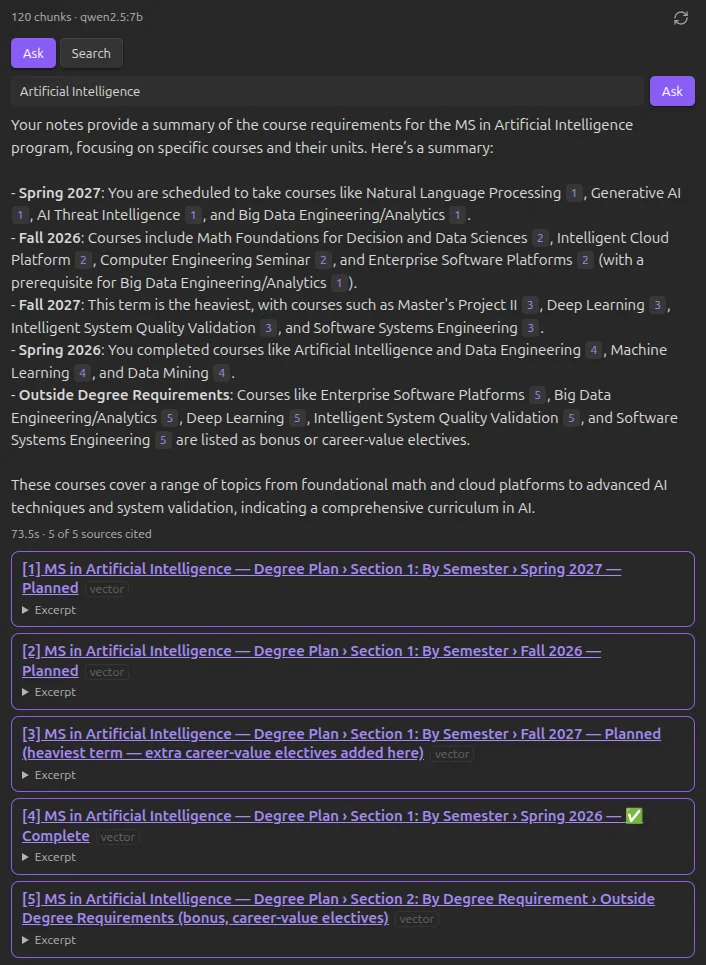
Architecture

- Indexing. Notes are parsed (frontmatter, tags, aliases,
[[links]]) and split by heading. Each chunk starts with a breadcrumb (Title (aliases) > Heading) so it makes sense on its own, then is embedded withnomic-embed-textinto Chroma. Re-indexing is incremental, per note. - Search returns ranked sections without calling an LLM: vector and BM25 results merged with Reciprocal Rank Fusion, in about 0.1–0.5 s.
- Ask gives the top 5 sections from vector search to
qwen2.5:7bvia Ollama, prompted to answer only from the numbered excerpts and cite them as[n]. A grounding check then verifies the answer against what it cites. - Three front ends, one pipeline: a FastAPI server that streams answers over Server-Sent
Events (with a single-file web UI), an Obsidian sidebar plugin that starts the server and
re-indexes as you edit, and an MCP server (
search,answer,reindex) for Claude Code, Claude Desktop or any MCP client.
Key decisions
Separate retrieval for Search and Ask
Hybrid search was best at putting the right section first: top 1 on both question sets, top 3 on the held-out set. That’s what a list of search results shows first, so Search uses hybrid.
At 5 results, the context Ask gives the model, hybrid and vector were mixed (dev 0.92 vs 0.97,
held-out 1.00 vs 0.90), and every answer benchmark had been run with vector. So Ask keeps vector
search at k=5. One function, build_retrievers(), defines both for every front end.
A deterministic grounding check instead of a better prompt
Both models fabricated during the experiments: one gave Redis’s default port, which the notes never mention; the other wrote “BRIN stands for Block Range INdex”, which is true but not in the notes. Each cited a note that didn’t say it. Changing the prompt moved the failure around rather than removing it.
The fabrications shared a pattern: the key detail wasn’t in the excerpt being cited. The check splits an answer into sentences, pulls out checkable details (multi-digit numbers, code, short quotes, multi-word names) and looks for each one in the excerpts that sentence cites. It needs no second model call, so it’s cheap, repeatable and easy to explain.
- Strict (CLI and MCP): sentences with unsupported details are removed, and the answer becomes a refusal if nothing cited remains.
- Warn (web UI and plugin): unsupported details are flagged after the answer, because streamed text is already on screen.
Graph expansion: tried twice, not the default
Obsidian’s link graph looked like an obvious advantage. Two versions (all of a note’s links, then only the links inside the retrieved section) were compared with vector search at the same number of chunks, so neither could win just by retrieving more.
Expanding by whole-note links scored lower than vector search (0.76–0.87 vs 0.89 at k=3, dev), and section-level links tied it on the held-out set. Linked notes are usually already similar to the question, so the link rarely adds anything the embedding missed, while hub notes and look-alike distractors push good results out. It stays available as an option.
Choose by rules fixed before the results
- Held-out questions were written before choosing a strategy or model, and run once.
- The model and prompt were picked by a rule set before seeing the grid: the most fully correct answers with zero made-up ones, because a fabricated citation is worse than no answer. qwen2.5:7b was more accurate but fabricated on the held-out set, so the faster llama3.2 stayed the default until the grounding check existed. With the check on, qwen2.5:7b took over.
- When the first benchmark saturated (vector search was perfect at top 3 on 18 notes), the vault grew to 59 notes with deliberate distractors, such as Adam and learning-rate notes next to Gradient Descent, and questions whose answer is only reachable through a link.
Incremental, failure-safe indexing
Each chunk stores a hash of its note and the embedding model’s name. Unchanged notes are skipped. Changed notes are embedded first and only then swapped in, so if Ollama fails mid-run the old index survives. Switching embedding models refuses to run until a rebuild, since vectors from different models aren’t comparable. The MCP server keeps its own index because Chroma isn’t safe for two processes writing at once.
Results
All results use a 59-note sample vault in the repo, with a development set and a held-out set of questions written before the final setup was chosen.
Search ranking
Score: the share of each question’s answer phrases found in the top 3 results, i.e. whether the right section was retrieved.
| Retrieval | Dev (31 questions) | Held-out (10 questions) |
|---|---|---|
| Question typed into Obsidian-style search¹ | 0.15 | 0.00 |
| Keyword (BM25) | 0.85 | 0.75 |
| Vector | 0.89 | 0.80 |
| Hybrid (vector + BM25) | 0.89 | 0.90 |
Hybrid ranks best on the held-out set and ties vector on dev, where it matches or beats vector on every question type. With 10 held-out questions, 0.90 vs 0.80 is a one-question difference.
¹ An approximation of Obsidian’s search bar, where every term must match. People type keywords into a search bar, not questions, so this measures the question-answering use case, not the search bar at its own job.
Answers
| Answer setup | Fully correct (dev / held-out) | Made-up answers | Time (CPU) |
|---|---|---|---|
| llama3.2 | 0.88 / 0.80 | 0 of 9 | ~6 s |
| qwen2.5:7b | 0.91 / 0.90 | 2 of 9 | ~13 s |
| qwen2.5:7b + strict grounding (default) | 0.91 / 0.90 | 1 of 9 | ~13 s |
“Made-up answers” counts the 9 questions the notes can’t answer, where the right response is a refusal. The one left under the default is a grading call rather than a fabrication: the answer (“calendar sync is next”) is in the notes, and the label was too strict.
Across about 470 saved answers, the grounding check caught all 3 fabrications observed and flagged 12 of 296 correct answers (4.1%), mostly harmless expansions of acronyms the notes don’t spell out.
Limitations
- Small benchmark. 59 synthetic notes, with 10 held-out retrieval questions and 17 held-out answer questions. Differences of one or two questions are noise.
- The grounding check’s numbers are optimistic. Its rules were refined while looking at the same saved answers, held-out ones included, so its real test is new answers. It checks surface details (numbers, names, quotes), so a made-up claim without one gets through.
- Strict-mode results are replayed, not live. They were computed on saved answers, which is equivalent because strict mode only edits the generated text.
- The streaming UI only warns. In the web UI and plugin, unsupported details are flagged after the answer rather than removed.
- Slow on CPU: about 13 s per answer with qwen2.5:7b (about 6 s with llama3.2).
- Parser gaps. Only
[[wiki-links]]in.mdfiles are read: standard Markdown links, links in frontmatter properties,.canvasfiles and attachments are not. - One real vault. Beyond the benchmark, Oracle has been tested on one private vault, and that test was qualitative.
Links
- Repository
- Dev log: every experiment, including the ones that didn’t work
- Evaluation results