Logbook
Grounded Q&A over 3,080 NASA aviation maintenance safety reports, with every cited report ID checked.
Problem
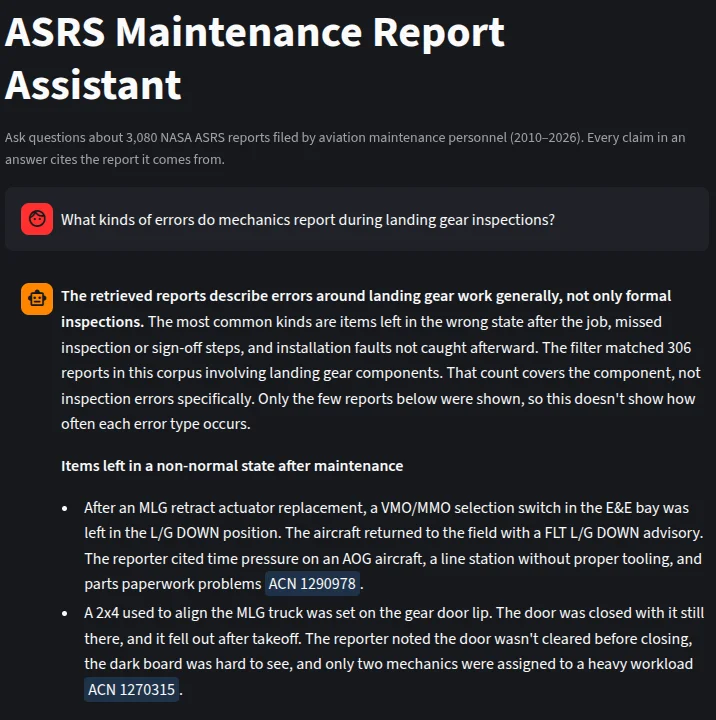
NASA’s Aviation Safety Reporting System (ASRS) collects voluntary, de-identified reports of safety incidents. Logbook covers its maintenance reports: 3,080 reports from 2010 to 2026, with 3,632 narratives written by technicians, inspectors and other maintenance staff. Each report also has fields coded by analysts, such as aircraft, component, human factors and anomaly.
Analysts’ questions mix the two. “Boeing 737 reports from 2022 to 2024” is a filter on coded fields. “Compare what reporters said about deferred maintenance in 2019 versus 2023” needs both a filter and the narratives. Logbook answers such questions in plain language and cites every claim to a report by its ID (ACN). It gives counts only for this corpus and never as real-world rates, because voluntary reports can’t support rates.
Architecture

- Data preparation. The ASRS export is loaded into DuckDB. ASRS’s own abbreviation list is written for flight operations and covers only 24% of the abbreviations in these narratives. A hand-curated maintenance supplement of 117 terms raises that to 60%, and overrides meanings that are wrong in a maintenance context (MM is Maintenance Manual, not Middle Marker). Expansion applies only to the text used for search; the original narratives are kept for display and citation.
- Build a filter. The LLM calls a
build_filtertool with a JSON spec: coded-field values, years, keywords and an optional grouping. The spec is validated before it runs, and the model sees only how many reports it matched. - Retrieve and answer. BM25 and dense embeddings (
bge-small-en-v1.5, run locally throughfastembed) each rank the filtered narratives, merged with reciprocal rank fusion. The answer model gets the filter with its counts and the top 10 narratives, and must cite each claim as[ACN n]. - Models. Each LLM step runs on Claude through the Anthropic API or on a local model through
Ollama, chosen separately per step. The Streamlit app, the command line and the evaluation all
call the same
answer()function, so what testers see is what gets evaluated.
Key decisions
Validate filters against the data, not just the schema
A model writing a filter can invent a value, such as “Spacecraft” as an aircraft model, which would quietly return nothing. Every value in a spec is checked against the values actually observed in the corpus. An invalid spec goes back to the model with the problems listed, including where a misplaced key belongs, and the model gets up to three calls.
The messages matter. Before they said where a key belonged, qwen3.5:9b deleted the years from
a filter to get it accepted (506 reports instead of 109). Afterwards it moved them to the right
place and matched 109.
Whole-word keyword matching
Keywords first matched as substrings, so “MEL” (Minimum Equipment List) also matched extremely
and timely, and “ISS” matched missing and issue. Keywords now match whole words with an
optional plural, and a trailing * matches a prefix (defer* for deferred and deferral).
Across the corpus, “MEL” went from 503 reports to 405, and “ISS” from 1,114 to 0.
Check every citation after generation
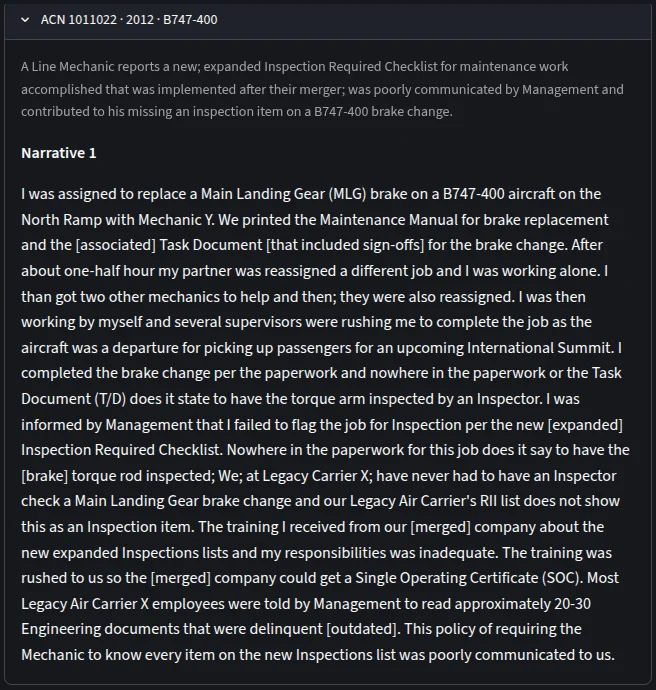
After the answer is written, every cited ACN is sorted into one of three groups: verified (a report the model was shown), not shown (a real report the model wasn’t given) or not in the corpus (fabricated). Only verified reports appear as sources. The app highlights each citation in blue if it passed and in red with ⚠ if it failed.
Citations are plain text rather than the Anthropic API’s citation feature, so a local model can follow exactly the same format. Narratives are HTML-escaped inside the prompt so a report can’t close its own tag and inject instructions.
No vector database
With 3,632 narratives, a brute-force NumPy dot product takes milliseconds, so the planned Chroma/FAISS store was dropped. Embeddings run locally on ONNX, so retrieval needs no network or GPU, and the local-model setup stays fully offline.
One question at a time, on purpose
Each question is answered on its own. Follow-ups like “tell me more about the second one” don’t work, but every evaluation run is single-turn and reproducible.
Results
The pipeline is complete. The scored evaluation is in progress: 25 queries with gold filters, comparing Claude with local models. The results below are a model screening, a smoke test and a side experiment, not that scored run.
Filter step: Claude vs local models
A screening on 3 queries, each chosen to exercise a different part of the filter spec: Boeing 737 reports from 2022–2024 (109 reports), deferred maintenance in 2019 vs 2023, and spacecraft, which has no coded value, so the right answer is 0 reports. Claude models ran 3 times each, local models twice, on a laptop CPU with no GPU.
| Model (runs) | Boeing 737 | Deferrals | Spacecraft | Calls accepted | Median time |
|---|---|---|---|---|---|
| Claude Haiku 5.5 (3) | 3 correct | 3 correct | 2 imprecise, 1 wrong | 10 / 10 | 2.9 s |
| Claude Opus 5.5 (3) | 3 correct | 3 imprecise | 2 correct, 1 imprecise | 12 / 12 | 6.1 s |
| gemma4:12b (2) | 2 wrong | 2 imprecise | 2 imprecise | 6 / 6 | 29 s |
| qwen3.5:9b (2) | 2 correct | 2 wrong | 2 correct | 4 / 14 | 76 s |
| llama3.1:8b (2) | 2 correct | 2 wrong | 2 wrong | 4 / 10 | 64 s |
| gpt-oss:20b (2) | 1 correct, 1 wrong | 2 wrong | 2 imprecise | 3 / 10 | 23 s |
| qwen3:30b-a3b (2) | 2 wrong | 2 correct | 2 wrong | 2 / 6 | 260 s |
“Imprecise” means a valid filter that’s broader or narrower than the gold one; for example, Opus added MEL and CDL keywords to the deferral filter.
- Both Claude models produced a valid call every time (22 of 22), and Haiku matched the gold filter exactly on the first two queries in every run.
- No local model got all three right in this round, and most of their failures were about format, not content: a correct filter sent as a text string, or JSON Ollama couldn’t parse.
- Reading tool calls written as text fixed the best local model.
qwen3:30b-a3bhad written correct filters as plain JSON instead of tool calls. Once the pipeline read those, it was correct on all three, at roughly 4–8 minutes per filter on this laptop.
Citations
In a smoke test on Claude, all 60 citations across 6 questions were verified. A question takes about 15–30 seconds and costs roughly $0.10 in API usage.
Side experiment: filling in a missing field
Analysts coded the deferred-maintenance flag for only 38% of reports, so deferral questions have to fall back on keywords. Could the flag be predicted from the narratives? Each model was scored on the same 237 held-out coded reports (69 deferred), using F1 on the deferred class:
| Model | F1 (95% CI) |
|---|---|
| Always “not deferred” | 0.00 (accuracy 0.71) |
Keyword rule (defer* or MEL) |
0.79 (0.71–0.86) |
| TF-IDF + logistic regression | 0.76 (0.68–0.84) |
| Sentence embeddings + logistic regression | 0.73 (0.65–0.81) |
| Claude Haiku 5.5, zero-shot | 0.82 (0.74–0.89) |
- Haiku scored highest, but not significantly. The keyword rule and Haiku disagree on 13 reports (McNemar exact test, p = 0.58).
- A one-line rule matched machine learning. Deferral is an administrative detail inside the story, not its topic, so embeddings trained to group texts by topic did worst.
- The labels set the ceiling. Both methods get the same 21 reports wrong. In about half of them the analysts coded “not deferred” although a deferral is plainly mentioned. A sharper definition in the prompt didn’t help, because the analysts aren’t consistent either.
- Not wired in. About one in five filled-in values would be wrong, and for the deferral question 6 to 8 of the top 10 retrieved reports stayed the same either way.
Limitations
- Not yet scored end-to-end. Generated filters haven’t been scored against the gold filters, the answer step has only been smoke-tested on 6 questions, and the model screening covers 3 queries.
- Valid filters can still be wrong. Validation rejects invented fields and values, but not a
filter that drops a constraint or splits into several.
gemma4:12badded the aircraft type as a keyword and matched 4 reports instead of 109. - Words used in another sense get through. For the spacecraft question, keyword filters matched “space” (hangar space) and “booster” (oxygen booster carts). The answer step has to reject them.
- Failed citations are flagged, not corrected.
- Long narratives are only partly embedded. 14% exceed the embedding model’s 512-token input, so dense retrieval sees only their opening; BM25 still scores the full text.
- No follow-up questions, and it runs locally only.
- Local models are slow on a laptop CPU: from about 20 seconds to several minutes per filter.